The snake plant is sold as the houseplant you cannot kill. Put it in a dark corner, forget about it, and it will still be there next year — and that is mostly true. What the label leaves out is the difference between surviving and thriving, and that difference is the whole point of this guide to snake plant care.
A snake plant in a dark corner survives: it stays alive, but it grows slowly, its leaves stay narrow, and the yellow edges on a variegated plant fade back to plain green. The same plant in bright indirect light, watered only when its soil has dried right through, grows tall and holds its colour. Both plants are alive. Only one of them is thriving.
The good news is that good snake plant care is mostly about doing less, not more. This plant stores water in its thick leaves, so it forgives a missed watering far more easily than an extra one. Almost every snake plant that dies is killed by kindness — watered on a schedule, potted in heavy soil, or set in a pot with no drainage. In this guide to snake plant care you will learn the one rule that prevents all of that, the light the plant actually wants, the soil and pot that keep its roots safe, and what to do when something looks wrong.
The One Rule of Snake Plant Care: The Deep-Dry Test
If you remember one thing from this guide, make it this: never water a snake plant until the soil is dry all the way through the root zone — not just dry on top. The top inch can be bone dry while the middle of the pot is still damp, and watering on the strength of a dry surface is how most snake plants end up rotting.
So check deep. There are two ways to do it, and the best snake plant care routine uses both.
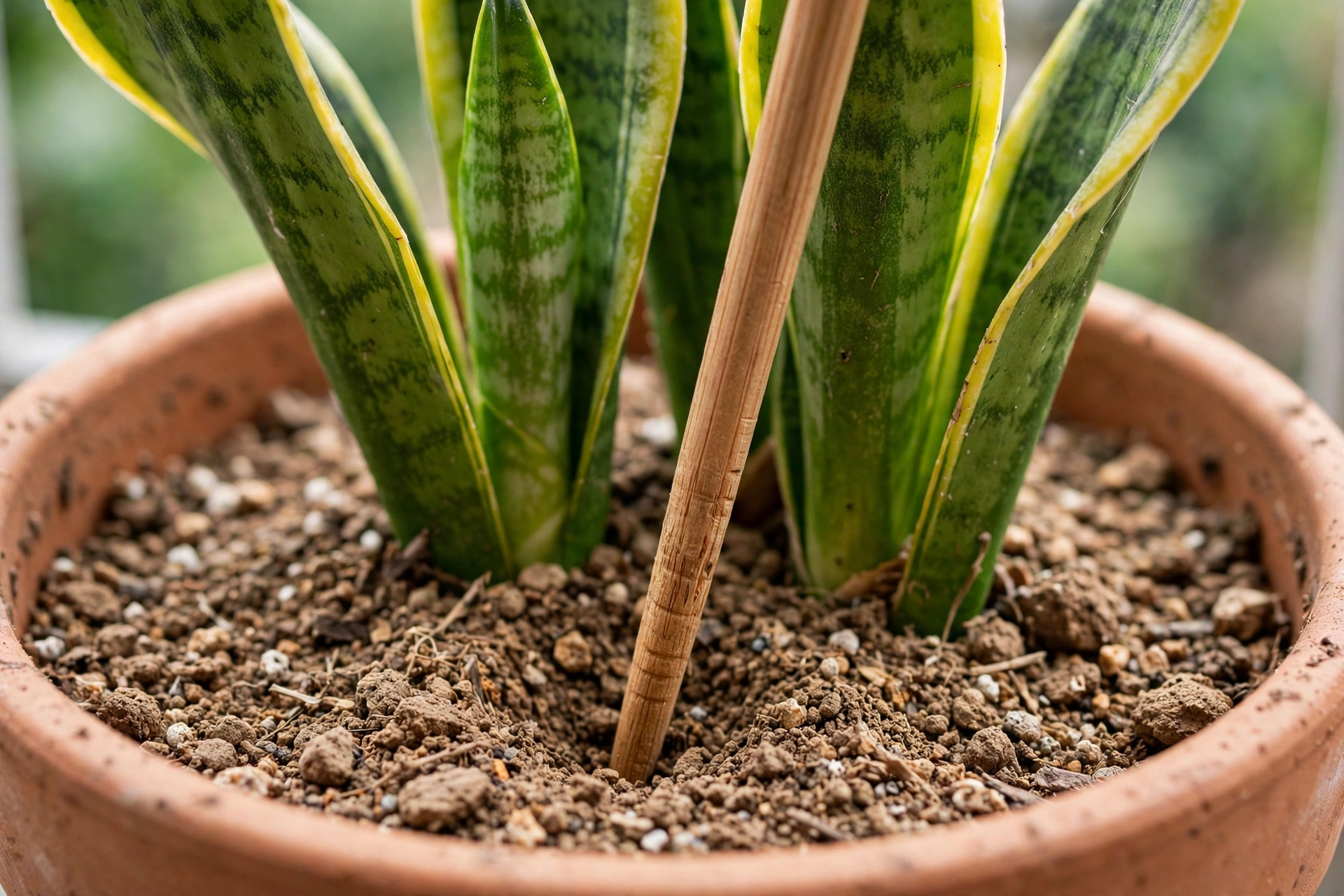
The chopstick test. Push a wooden chopstick or bamboo skewer deep into the soil, near the bottom of the pot, and leave it a minute. Pull it out: dark soil clinging to the wood means the soil is still wet — wait. Clean and dry means it is time to water. This one test replaces every watering calendar. Light, pot material, and season all change how fast a pot dries, so no fixed schedule can be right for every home.
The lift-the-pot test. Pick the pot up: a freshly watered pot is noticeably heavy, a dry pot is light. After a few weeks of lifting it before and after watering, you will know the weight of a dry pot by feel. Terracotta makes this easier, because it is porous and dries faster than glazed ceramic or plastic.
When the test says dry, water thoroughly: pour slowly at soil level until water runs out of the drainage hole, then empty the saucer after ten minutes. Never let the pot sit in water. When the test says damp, walk away. That is the whole routine, and it is the heart of snake plant care — the soil decides, not the calendar.
Warning: never pour water into the centre of the rosette. A snake plant grows as a rosette of stiff leaves, and water that pools where the leaves meet the base sits there and rots the plant from the inside. Always water at soil level, around the base of the leaves, never down into the crown. It is one of the easiest mistakes to make and one of the hardest to fix, because by the time the damage shows, the rot is already in the base of the leaves.
Light: What a Snake Plant Actually Wants
Snake plants are famous for tolerating low light, and they do — but tolerating is not the same as enjoying. A snake plant in a dim hallway will live for years and barely grow; a few feet from a bright window, the same plant grows faster, stands taller, and keeps the yellow variegation that low light slowly washes out. If your snake plant has stopped growing, or its new leaves come in narrower and greener than the old ones, light is the first thing to check — one of the simplest fixes in snake plant care.
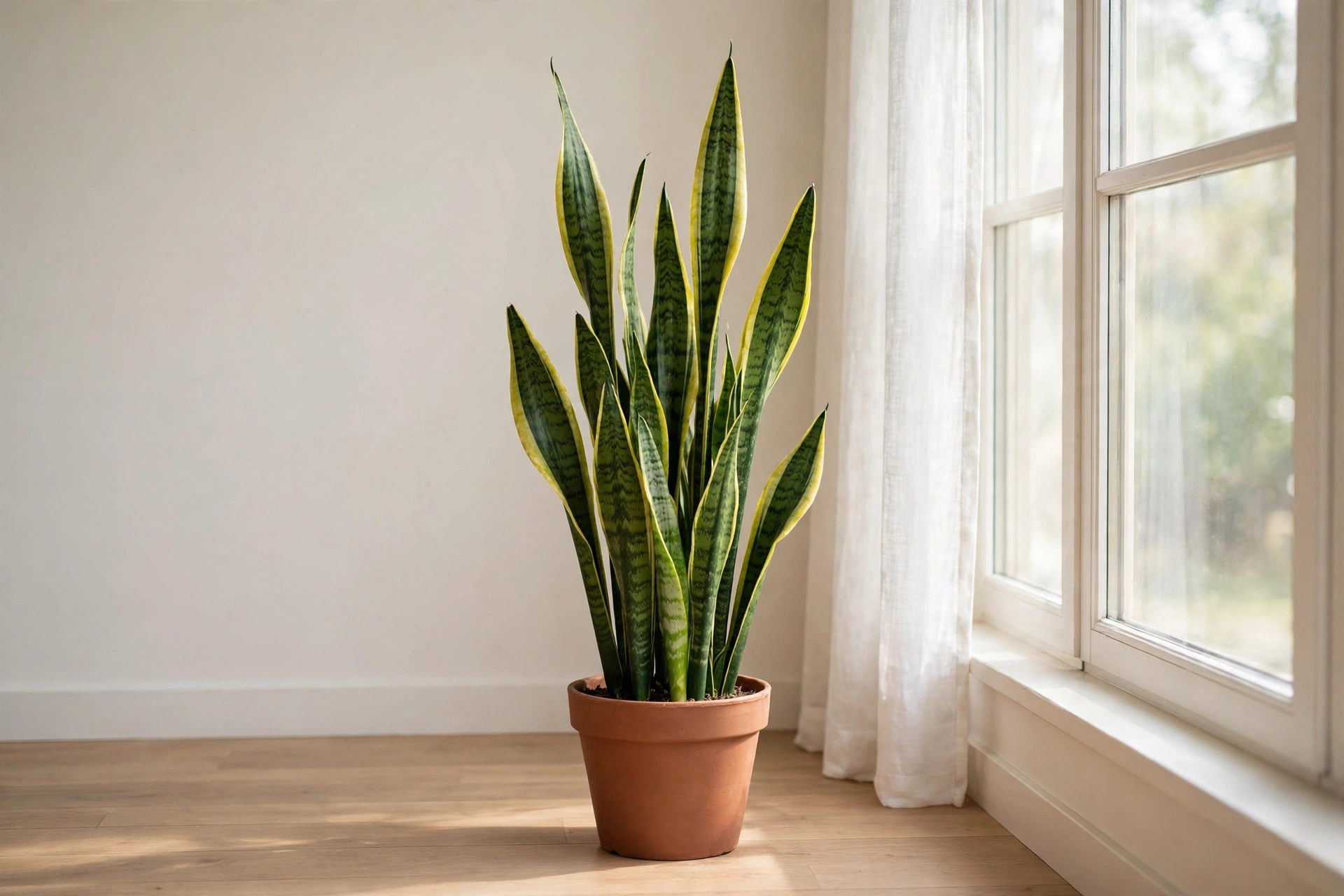
Bright indirect light is the sweet spot. An east-facing window, with gentle morning sun, is an easy start. A spot a few feet back from a south- or west-facing window works too, as long as the sun does not fall directly on the leaves for hours. That one change — more light — is the fastest upgrade in snake plant care.
Direct afternoon sun scorches the leaves. A plant moved straight from a shop shelf into a hot south-facing window can develop pale, bleached patches or dry brown edges. If the only bright spot you have gets strong afternoon sun, set the plant back a foot or two, or hang a sheer curtain between it and the glass. Morning sun is gentle; afternoon sun is not.
Low light is survivable, not ideal. If a dark corner is the only place you have, the plant will cope — just expect very slow growth, and water it less often, because the soil takes much longer to dry. This is the part of snake plant care most people get backwards: a plant in low light needs less water, not the same amount, and watering it on a bright-light schedule is a fast route to root rot.
Watering: How Often, and Why the Calendar Lies
Ask ten guides how often to water a snake plant and you will get ten different answers — every two weeks, every three weeks, once a month. All of them are roughly right, and none of them is right for your plant in your home. The honest answer, and the one at the centre of snake plant care, is this: water when the deep-dry test says dry, and not before.
As a rough guide only, most indoor snake plants in bright light need water roughly every two to four weeks in the growing season, and less often in winter, when growth slows and the soil stays damp longer. But these are rough guides, not rules — a small plant in terracotta by a sunny window can dry out in a week, while a big plant in a glazed pot in a cool room can stay damp for six. In snake plant care, the soil test is the authority; the calendar is only a guess.
A few habits matter more than the interval:
- Water at soil level, never into the rosette. Pour slowly around the base of the leaves, at the surface of the soil, and keep water out of the crown where the leaves meet. Standing water in the rosette rots the leaf bases, and a leaf that has gone soft at the base does not recover.
- Water thoroughly when you do water. A little splash wets the top inch and leaves the deep roots dry. Pour slowly until water runs from the drainage hole, so the whole root zone is wet.
- Always empty the saucer. Ten minutes after watering, tip out whatever has collected underneath. A pot sitting in water keeps the bottom of the soil wet long after the top has dried, and that is where root rot starts.
- When in doubt, wait. A snake plant stores water in its leaves, so it can go without for weeks; it cannot recover from roots that have rotted in wet soil. If you are not sure it is dry enough, give it a few more days — waiting is almost never the wrong choice in snake plant care.
Use room-temperature water where you can — cold water straight from the tap can shock the roots, especially in winter. Get the watering right and the rest of snake plant care is easy.
Soil and Pot: The Drainage Setup That Prevents Root Rot
Root rot is the number one killer of snake plants, and it almost always starts in the pot, not in the watering can. The roots are adapted to dry, gritty soil that drains fast; sitting in heavy, wet potting mix is the one condition they cannot handle — and the fix is decided before you ever pick up the watering can.
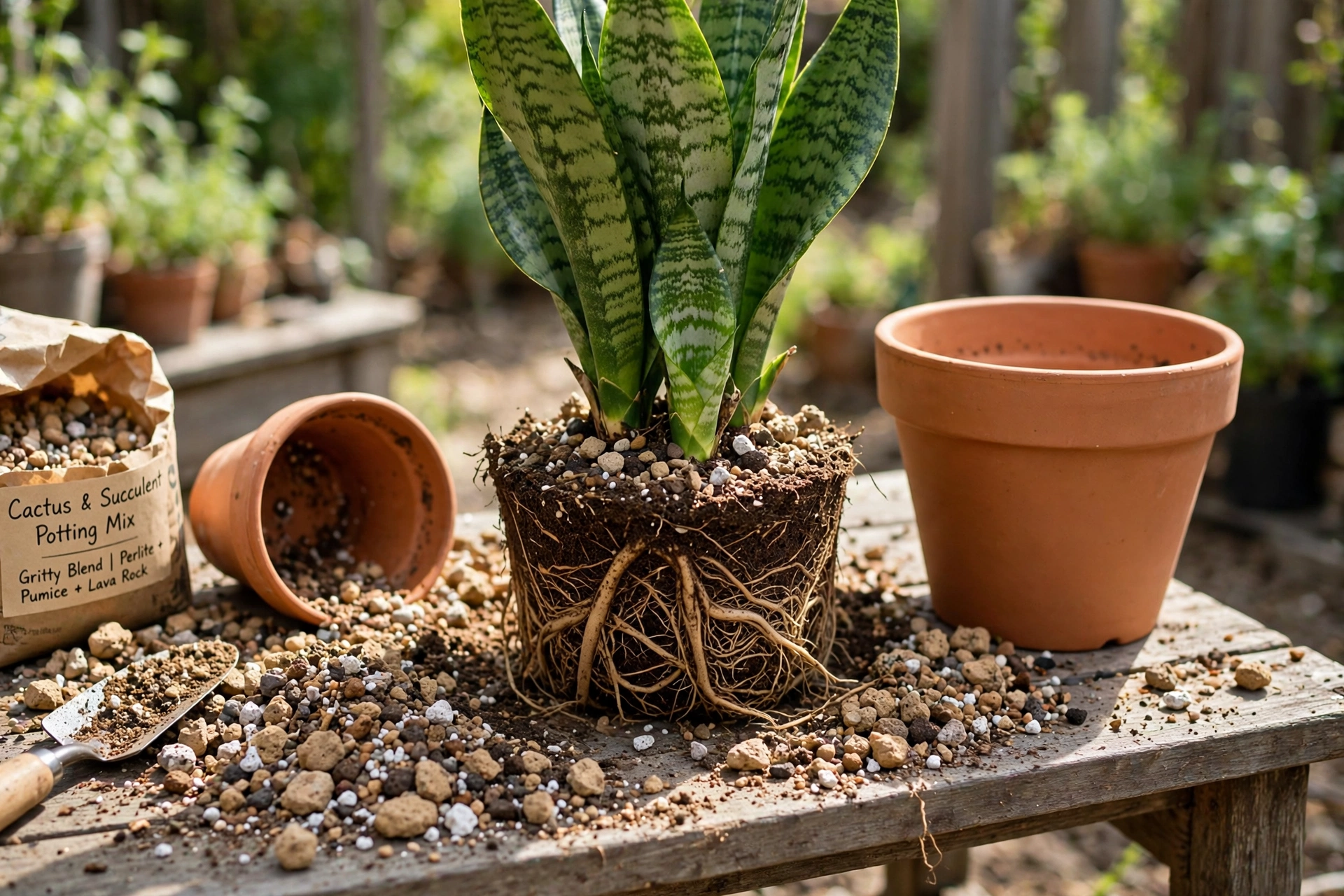
The mix should be gritty and fast-draining. A cactus or succulent mix works well straight out of the bag, and it gets better with a handful of perlite mixed in. One easy recipe is roughly equal parts indoor potting soil and cactus or succulent mix, with perlite added until the mix feels open and crumbly. Ordinary potting soil on its own holds too much water; it stays wet for too long, and the roots suffocate. If your mix still feels damp a week after watering, it is too heavy — add more perlite, or switch to a cactus mix. Getting the mix right is the most practical step in snake plant care, because it makes every watering safer.
The pot must have a real drainage hole. This is not optional: a decorative pot without a hole traps water at the bottom no matter how carefully you water, and that trapped water is where rot begins. If you love a pot without drainage, use it as a cover pot — keep the plant in a plastic nursery pot with holes inside it, and lift the inner pot out to water and drain.
Keep the pot small. A snake plant likes a snug pot — only slightly wider than its root ball — and pot size is an underrated part of snake plant care: a big pot holds far more wet soil than the roots can drink, so the mix stays damp for weeks and the roots rot. Our guide to choosing container gardening containers covers pot size and drainage, and the same logic applies indoors.
Terracotta is a good choice. Unglazed terracotta is porous, so it pulls moisture out of the soil and dries faster than glazed ceramic or plastic — a safety net for a plant that hates wet feet.
Temperature and Where to Put It
Snake plants are tropical plants, and they like the same temperatures you do. Keep them above 50°F (10°C) and they will be comfortable — normal indoor temperatures suit them fine all year, and temperature is the easy part of snake plant care. What they do not like is cold: a plant left against cold window glass in winter, or beside a draughty exterior door, can develop soft, dark patches where the cold touched it.
Keep it away from cold draughts, radiators, and heating vents: hot dry air dries the leaf tips, and a cold draught in winter does real damage. The best spot is a bright room with stable temperatures, away from doors that open outside. Indoors all year is perfectly fine for snake plant care — and simpler.
Feeding: Light, Rare, and Easy to Overdo
Feeding is the smallest part of snake plant care, and the easiest to overdo. A snake plant needs very little of it, and overfeeding is a more common problem than underfeeding. In most homes, a light feed in the growing season is all it will ever need — and in low light, it may need none at all.
Feed at half strength with a balanced liquid houseplant fertiliser, once or twice in spring and summer, when the plant is actively growing. Do not feed in autumn or winter, when growth slows, and never feed a plant that is stressed, newly repotted, or recovering from rot — fertiliser on damaged roots burns them.
Signs of overfeeding are brown, dry leaf tips and a white crust of salts on the soil surface. If you see that, flush the soil with plain water until it runs freely from the drainage hole, and skip feeding for the rest of the season. The plant grows slowly by nature — no amount of fertiliser will make it grow fast, it will only burn the roots. When it comes to feeding, restraint is the rule in snake plant care.
Repotting: When NOT to Repot
Here is the part of snake plant care that surprises most people: your snake plant probably does not need repotting this year. Or next year. Snake plants grow better pot-bound than most houseplants — they are slow growers, and a snug pot suits them. In low light, a snake plant can happily stay in the same pot for five to ten years; in brighter light it may need a new pot sooner, but still far less often than most houseplants.
Do not repot on a schedule. In snake plant care, repotting is a response to a problem, not a routine. Repot only when you see a real reason:
- Roots are cracking or splitting the pot, or pushing hard out of the drainage hole.
- Growth has stalled for a whole season even though light and watering are right, and the pot is visibly full of roots.
- The soil has gone stale — it stays wet for weeks, smells sour, or has broken down into a dense, soggy mass.
When you do repot, go up only one pot size, use fresh gritty mix, and water lightly — then leave the plant alone for a week or two while it settles. Spring is the best time. Dividing the plant while you repot is also the easiest way to make more snake plants: pull the rhizome apart into sections, each with leaves and roots of its own, and pot each one up. Leaf cuttings work too, but they are slower — and a cutting from a variegated plant usually grows back plain green, so divide if you want to keep the yellow edges.
Troubleshooting: What Your Snake Plant Is Telling You
Most snake plant problems have one of two causes: too much water, or too little light. Read the symptoms below before you reach for a remedy — the fix is usually simpler than it looks.
Leaves going yellow, soft at the base, or flopping over. This is the classic sign of overwatering and root rot, and the most serious problem a snake plant can have. If the soil is wet and the base of the leaves feels soft or mushy, act fast: take the plant out of its pot, cut away any black, mushy roots and any leaves soft at the base, let the healthy parts dry for a day, then repot into fresh, dry, gritty mix in a pot with drainage. Do not water for a week afterwards. A leaf that has gone soft at the base will not recover — remove it so the rot cannot spread to the rhizome.
Brown, dry leaf tips. Dry brown tips usually mean inconsistent watering, hot dry air, or a build-up of salts from overfeeding or hard tap water. Trim the tip off with clean scissors, following the natural point of the leaf, and check your feeding and watering habits. If your tap water is very hard, try rainwater or water left standing overnight.
Leaves wrinkling or curling inward. Wrinkled, curling leaves are a thirsty plant — the leaves are using up their stored water. This is the opposite of rot: the soil has been dry for too long. Water thoroughly, let it drain, and check the soil more often for a while; a wrinkled leaf usually plumps back up within a few days.
Slow growth or no new leaves. Slow growth is the most common complaint in snake plant care, and the answer is almost always light: move the plant to a brighter spot and give it a season. In low light, growth is slow by nature — normal, not a failure. Feeding will not fix a light problem.
If your snake plant’s leaves are yellowing, start with the soil, not the leaf: a yellow leaf almost always points back to watering — too much water far more often than too little — and the deep-dry test will tell you which one it is. That test-first habit is the most useful skill in snake plant care.
Pet Safety: Keep It Out of Reach of Dogs and Cats
This one matters, and it is verified, not guessed. The ASPCA lists Sansevieria trifasciata — the snake plant, also called mother-in-law’s tongue — as toxic to dogs and cats. The plant contains saponins, which can cause nausea, vomiting, and diarrhoea if a pet chews or eats the leaves. It is not usually life-threatening, but it is unpleasant and worth taking seriously.
If you have a dog or a cat that chews plants, keep the snake plant somewhere they cannot reach it — a high shelf, a hanging planter, or a room they do not use. If a pet does eat part of a leaf, contact your vet and mention the plant by name. For the full listing, see the ASPCA’s page on mother-in-law’s tongue. Pet safety is a part of snake plant care that new owners often miss — check it before you bring the plant home, not after.
For people, snake plant care carries no such warning — but wash your hands after handling cut leaves, as you would with any houseplant.
The Opposite Plant: Why a Poinsettia Needs the Reverse Habit
If you have just bought a poinsettia for the holidays, here is a useful warning from the other end of snake plant care: it needs the opposite of everything this guide has just told you. A snake plant thrives on neglect — dry roots, water rarely, leave it alone. A poinsettia needs consistent moisture and stable warmth, and it sulks fast if it dries out or gets cold. If you over-water every plant in the house, start with a snake plant; if you bought a poinsettia this week, it needs the opposite habit — our guide to poinsettia plant care covers exactly what that looks like.
A Year of Snake Plant Care, at a Glance
Good snake plant care is not a weekly chore — it is a short routine that changes with the seasons.
- Spring: the growing season starts — the time to repot if the plant needs it, to divide or take leaf cuttings, and to give one light feed at half strength. Move the plant to its brightest spot as the days lengthen.
- Summer: growth is fastest, and the soil dries quickest. Check with the deep-dry test more often, and water when it says dry — a plant in a sunny spot may need water every couple of weeks, a plant in a cool room less.
- Autumn: growth slows as the light fades. Water less often, stop feeding, and move the plant away from cold window glass.
- Winter: the quiet season. The plant may need water only once a month or less — in low light, possibly not at all for weeks. Do not feed, do not repot, and keep it above 50°F (10°C), away from cold draughts. If the leaves start to wrinkle, the plant is thirsty — water it, but do not start a schedule.
Through it all, the routine stays the same in snake plant care: test the soil, water only when it is dry through, water at soil level, and empty the saucer.
Frequently Asked Questions
How often should I water a snake plant?
There is no fixed schedule, and that is the first thing to understand about snake plant care. Water only when the soil is dry all the way through the root zone — check with the chopstick test or by lifting the pot. As a rough guide, most indoor snake plants need water every two to four weeks in the growing season and less often in winter, but the soil test is the authority, not the calendar.
Can a snake plant live in low light?
Yes, it can survive in low light — but it will not thrive there. In a dim corner, a snake plant grows very slowly, its leaves stay narrow, and variegated types lose their yellow edges. For the best snake plant care, give it bright indirect light — an east-facing window, or a few feet back from a south- or west-facing window — and keep it out of direct afternoon sun.
Why are my snake plant’s leaves turning yellow?
Yellow leaves almost always mean too much water. Check the soil with the deep-dry test: if it is wet and the base of the leaves feels soft, the roots are rotting. Take the plant out, cut away black mushy roots and any soft leaves, and repot into fresh, dry, gritty mix in a pot with drainage. Getting the watering right is the foundation of snake plant care.
How do I know when to repot a snake plant?
Repot only when there is a real reason: roots cracking the pot, growth stalled for a whole season, or soil that has gone stale and stays wet. Snake plants like being pot-bound and can stay in the same pot for years — in low light, five to ten years is not unusual. When you do repot, go up only one pot size, use fresh gritty mix, and do it in spring — that patience is part of good snake plant care.
Is a snake plant safe for pets?
No — the ASPCA lists the snake plant (Sansevieria trifasciata, also called mother-in-law’s tongue) as toxic to dogs and cats. It contains saponins, which can cause nausea, vomiting, and diarrhoea if eaten. Keep it out of reach of pets that chew plants, and contact your vet if a pet eats part of a leaf. Pet safety is worth checking as part of snake plant care before you bring any new plant home.
Final Word
Snake plant care is mostly the art of leaving the plant alone. Give it bright indirect light, a gritty mix in a pot with drainage, and water only when the soil has dried right through — tested deep, not guessed from the surface — and it will look after itself for years. It needs an owner who checks the soil before watering, keeps water out of the rosette, and trusts the plant to say what it needs — and that is all snake plant care really asks of you.
That is the real lesson of snake plant care: the plant sold as unkillable is not unkillable — it is just very forgiving of neglect and very unforgiving of overwatering. Get the watering right, and everything else is easy. Start with the chopstick test this week, and your snake plant will still be standing tall, green and gold, long after the fussy plants on the same shelf have given up. That is what good snake plant care looks like in practice — less doing, more noticing. Less doing, more noticing: that is snake plant care at its simplest.
Further reading: the ASPCA’s listing for mother-in-law’s tongue and HGTV’s guide to how often to water a snake plant.
Pingback: Poinsettia Plant Care: Keep It Bright Through the Holidays