A poinsettia is the one plant most of us buy without planning to. It comes home in a gold foil sleeve sometime in late November, sits on the sideboard through December — and too often starts dropping leaves within a week, until by New Year it is a bare stem in a pot. That is not because poinsettias are hard plants. It is because good poinsettia plant care is the opposite of instinct: water it like a thirsty tropical, park it by the front door, leave the foil on.
This guide to poinsettia plant care follows the plant from the shop to January: the first 24 hours, light, watering, temperature, the foil trap, and the leaf-drop diagnosis that tells you what actually went wrong. It also says one thing most guides skip: a plant bought in late November will not recolour by this Christmas.
This Christmas vs Next Christmas: The Honest Bit First
Here is the most important thing about poinsettia plant care in late November: the colour on the plant you just bought was set in the greenhouse, weeks before you saw it. A poinsettia only turns red after eight to ten weeks of long, completely dark nights from early October. A plant bought in late November 2026 has already had that treatment — it will not get a second round of colour by this Christmas.
That is not bad news. It means poinsettia plant care this December has a simpler job: keep the plant you bought looking good through the holidays. Hold the colour it already has, keep the leaves on, and enjoy it. Reblooming is a project for next Christmas, starting in October 2027 — see the short section near the end.
The First 24 Hours: Getting It Home
Poinsettia plant care starts before the plant reaches your house — the trip home is where more poinsettias are damaged than most people realise. This plant comes from warm greenhouses and hates cold air — a few minutes in a freezing car boot or a walk down a cold street can chill it badly enough that the leaves start dropping a day or two later.
Buy from a warm display. Pick one from inside the shop, not from a table by the cold doorway or out on the pavement — a plant that has sat in a draught all day has had a bad start. Check the leaves are firm and green all the way down, with no yellowing at the base, and the red bracts bright and unmarked. Avoid plants with leaves already on the floor around the pot.
Wrap it for the trip. If the weather is cold, wrap the plant in paper or a plastic bag before you take it outside — most garden centres will do this. The wrapping only needs to last the journey; do not leave a wrapped plant in a cold car while you do other shopping.
Unwrap it as soon as you get home. Take the wrapping off straight away, and the foil sleeve off the pot too — that matters enough to have its own section below. Put the plant in its spot and water only if the surface feels dry; if it is still damp, leave it alone. The first day of poinsettia plant care is mostly about letting the plant settle: warm room, bright spot, no fussing.
Light: Bright and Indirect, for Six Hours a Day
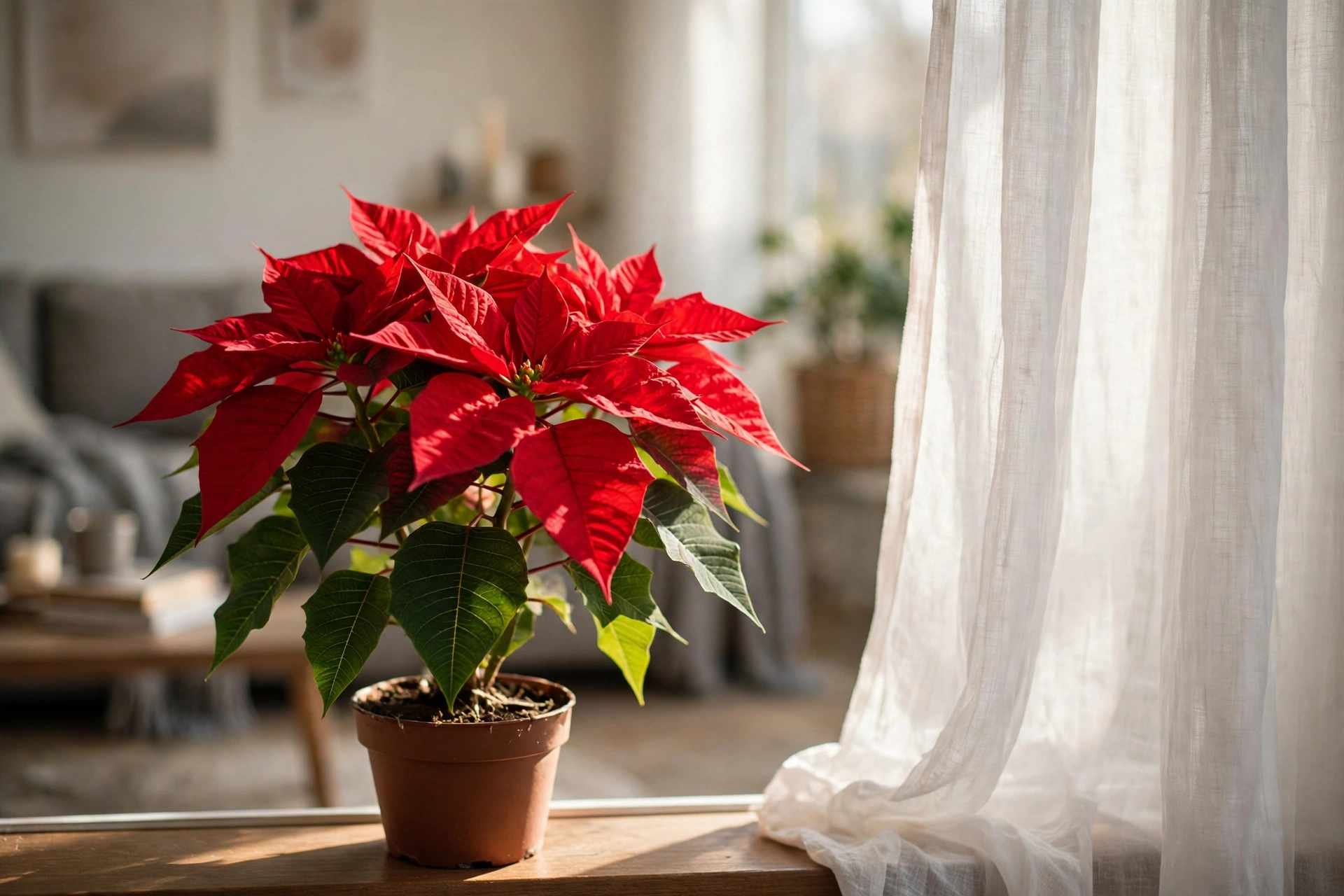
Light is the first thing to get right in poinsettia plant care, because everything else depends on it. A poinsettia needs bright, indirect light for at least six hours a day — a spot near a south-, east- or west-facing window is ideal, as long as the sun is not beating directly onto the leaves for hours. A few hours of gentle winter sun is fine, but strong sun through glass can scorch the bracts.
Too little light is the most common reason a poinsettia fades. In a dark corner, the plant stretches towards the window, the stems go leggy, and the red bracts fade to a washed-out pink. If your poinsettia is on a sideboard in the middle of the room, move it closer to the window — a few feet makes a difference. A bright ceiling light will not do the job — poinsettias need real daylight, not a lamp. That is the first rule of poinsettia plant care: if the plant cannot see the sky, move it closer. Once you have found a good spot, leave the plant there — poinsettias dislike being moved, and good poinsettia plant care is mostly choosing well once and then leaving the plant alone.
Watering: The Surface-Dry Rule and the Lift-the-Pot Test
Watering is where most poinsettias are lost: both too much and too little water cause the same first symptom — leaves dropping. So the goal of poinsettia plant care is not to water on a schedule, but to water when the plant needs it. Two tests tell you when, and together they are the whole rule.
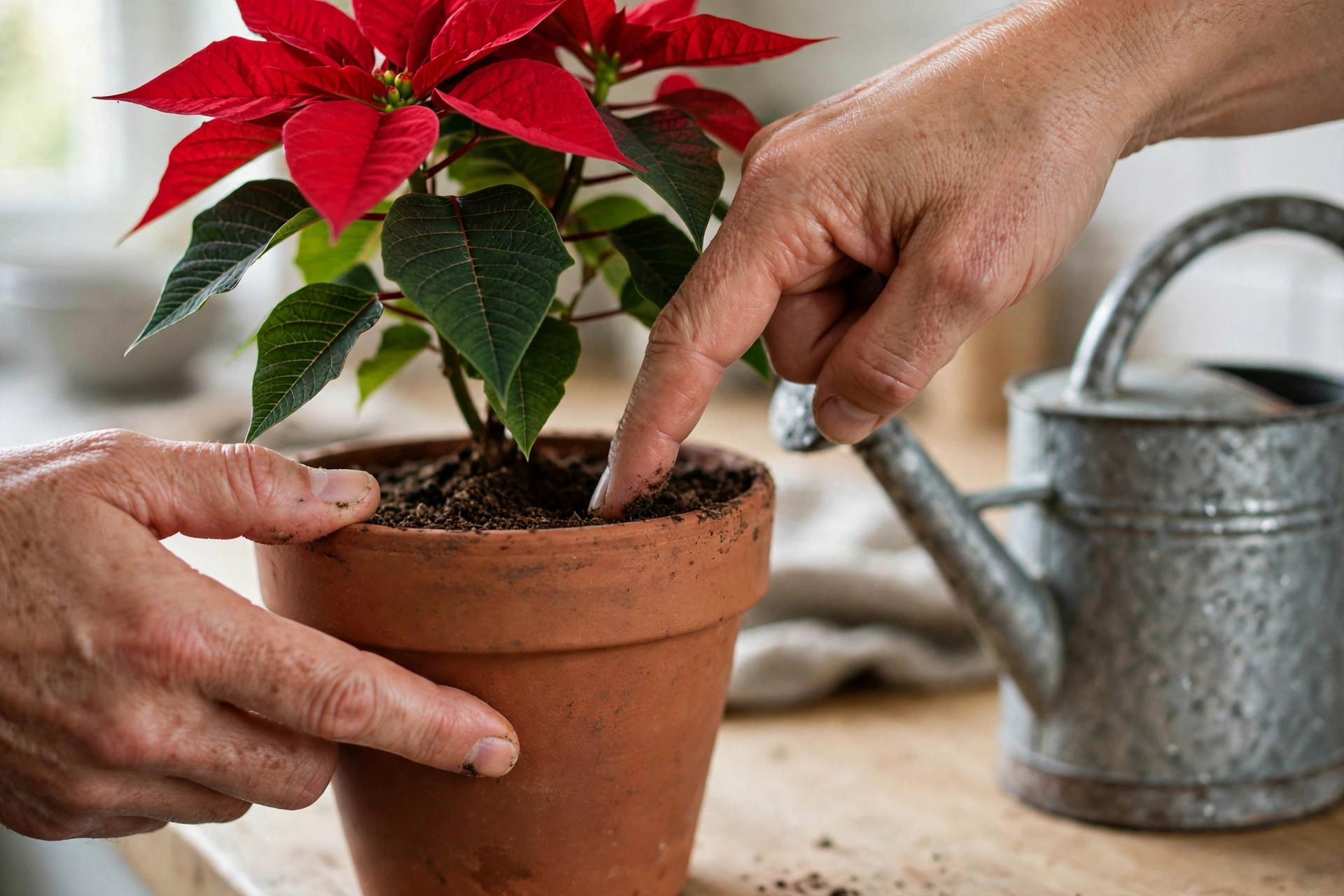
The surface-dry test. Push a finger into the soil about an inch down: dry means water, damp means wait. Check every two or three days rather than watering on a fixed day — a small pot in a warm room dries far faster than a big pot in a cool one. As a rough guide only, most poinsettias in a heated room need water every five to eight days in winter — a guide, not a rule. The finger test is the rule in poinsettia plant care.
The lift-the-pot test. Pick the pot up: a pot that needs water feels noticeably lighter than one just watered. After a few weeks you will know the difference by feel alone — the fastest check in poinsettia plant care.
When you do water, water properly. Take the plant to the sink, water slowly until it runs out of the drainage holes, and let it drain completely. Never leave a poinsettia standing in water — not in a saucer, a cache pot, or the foil sleeve it came in. Standing water is the most common cause of root rot. Empty the saucer after watering, every time.
A poinsettia is not a cactus, but it is not a thirsty tropical either. Good poinsettia plant care keeps the soil evenly moist — damp, never soggy, never bone-dry for days. If you overwater everything, this is the plant that will teach you restraint. If you want a houseplant that forgives the opposite habit, our guide to snake plant care covers a plant that genuinely prefers to be left dry — the opposite end of the spectrum.
Temperature: Stable Warmth, No Draughts
A poinsettia wants a stable 60–70°F (16–21°C), roughly the same day and night. In poinsettia plant care, temperature is simple: not near a cold draught, and not near a radiator — both extremes make it drop leaves.
Keep it away from exterior doors — especially the front door, opening and closing all day in December — and away from radiators, fireplaces, vents, and cold glass. A spot a few feet back from a window is usually better than one pressed against the glass, which gets cold at night. The same goes for a cold hallway: a beautiful spot for a Christmas plant, and a bad one for poinsettia plant care.
If your home swings between hot and cold, pick the steadiest room you have — in poinsettia plant care, stable warmth matters, because the plant was raised in a greenhouse.
The Foil Trap: Take It Off
Almost every poinsettia is sold in a decorative gold or red foil sleeve, and that sleeve is the quietest killer in poinsettia plant care. It looks festive, and it holds water at the bottom of the pot — water that has nowhere to go, because the foil has no drainage holes. Water collects inside it every time you water, and the roots sit in it.
Take the foil off when you get the plant home, or at least poke drainage holes in the bottom and always empty it after watering. Better still, stand the pot in a plain saucer you can see and empty — a poinsettia in a bare pot is far safer than one hidden in shiny foil. If you like the look, keep the foil as decoration around the outside of a saucer, as long as water can escape from the bottom.
The same principle applies in poinsettia plant care to any decorative outer pot with no drainage hole. Our guide to choosing container gardening containers explains pot size and drainage, and the logic is the same indoors: a pot that cannot drain will eventually drown its plant. If your poinsettia’s outer pot has no hole, treat it as a cover — lift the inner pot out, water, let it drain, and put it back.
Feeding: None While It Is in Bloom
There is almost nothing to say about feeding in poinsettia plant care, and that is the point: do not fertilise a poinsettia while it is in bloom. The plant is not growing new leaves in December; it is holding the colour it already has. Feeding it now does not make the bracts redder, and it can burn the roots or push out soft, leggy growth. If you keep the plant after Christmas, a balanced liquid feed at half strength, every few weeks through the growing season, is plenty — but during the holidays, the answer is simple: no fertiliser at all. The best poinsettia plant care in December leaves the plant alone.
It Is Not a Flower: Why the Red Parts Are Leaves
Here is a small fact that explains a lot about poinsettia plant care: the red parts are not flowers. They are bracts — coloured leaves around the true flowers, the tiny yellow clusters in the centre. The plant turns those leaves red to attract pollinators.
That is why, in poinsettia plant care, the colour fades when the light is poor, and why darkness — not feeding — brings it back. The bracts are leaves, and like all leaves they need light to hold their colour. Colour is also the first thing to go when the plant is stressed: cold, drought, or darkness fade the bracts first. If your poinsettia’s red is turning pale, check the light first, then the watering.
Leaf Drop: Work Out What Went Wrong
Leaf drop is the symptom that brings most people to a poinsettia plant care guide, and the one that tells you the least — almost everything that can go wrong with a poinsettia starts with leaves dropping. Look at what else is happening at the same time; this table is the fastest way to diagnose it.
| Symptom | Likely cause | What to do |
|---|---|---|
| Leaves drop, soil wet for days, pot heavy | Too much water | Stop watering, let the soil dry, empty the saucer and foil |
| Leaves drop, soil bone-dry, pot light, plant wilting first | Too little water | Water thoroughly at the sink, let it drain, then check every two or three days |
| Leaves drop, plant near a door, window or radiator | Cold or heat stress | Move it somewhere warm and stable, away from doors, radiators and cold glass |
| Lower leaves yellow, then drop, rest of plant fine | Often natural ageing, or a short spell of low light | Check the light first; if only the oldest leaves are going, it may just be settling in |
| Leaves drop a day or two after bringing it home | Cold damage on the journey | The damage was done in transit. Keep it warm and steady; it may recover, but badly chilled leaves rarely come back |
Leaf drop is a common symptom across houseplants, and our guide to why pothos leaves turn yellow explains how to work through yellowing leaves on a pothos. But poinsettia leaf drop has its own causes — cold, draughts, and wet feet — so do not treat the pothos diagnosis as the poinsettia answer. Act on the cause you find: check the soil, lift the pot, and look at where the plant is standing. Most leaf drop in poinsettia plant care comes down to one of the three rows at the top of that table.
Pets and Children: The Poison Myth, Corrected
Poinsettias have a frightening reputation they do not deserve. People have repeated for years that poinsettias are deadly poisonous — it is not true, and it should not be repeated. Here is what trustworthy sources actually say, so your poinsettia plant care decisions are based on facts rather than a myth.
The ASPCA lists poinsettia (Euphorbia pulcherrima) as toxic to dogs and cats, because the milky white sap irritates the mouth and stomach — but calls the plant’s toxicity “generally over-rated.” Pet Poison Helpline says the same in plainer language: poinsettias are only mildly toxic to cats and dogs, and the danger is greatly exaggerated. If a pet chews a leaf, the usual signs are drooling, lip-licking, or mild vomiting, sometimes a little diarrhoea; the sap can also irritate skin where it touches. Signs are generally self-limiting and usually need no treatment unless severe or persistent — but if your pet shows symptoms, call your veterinarian for advice rather than guessing. Read the full detail on the Pet Poison Helpline poinsettia page.
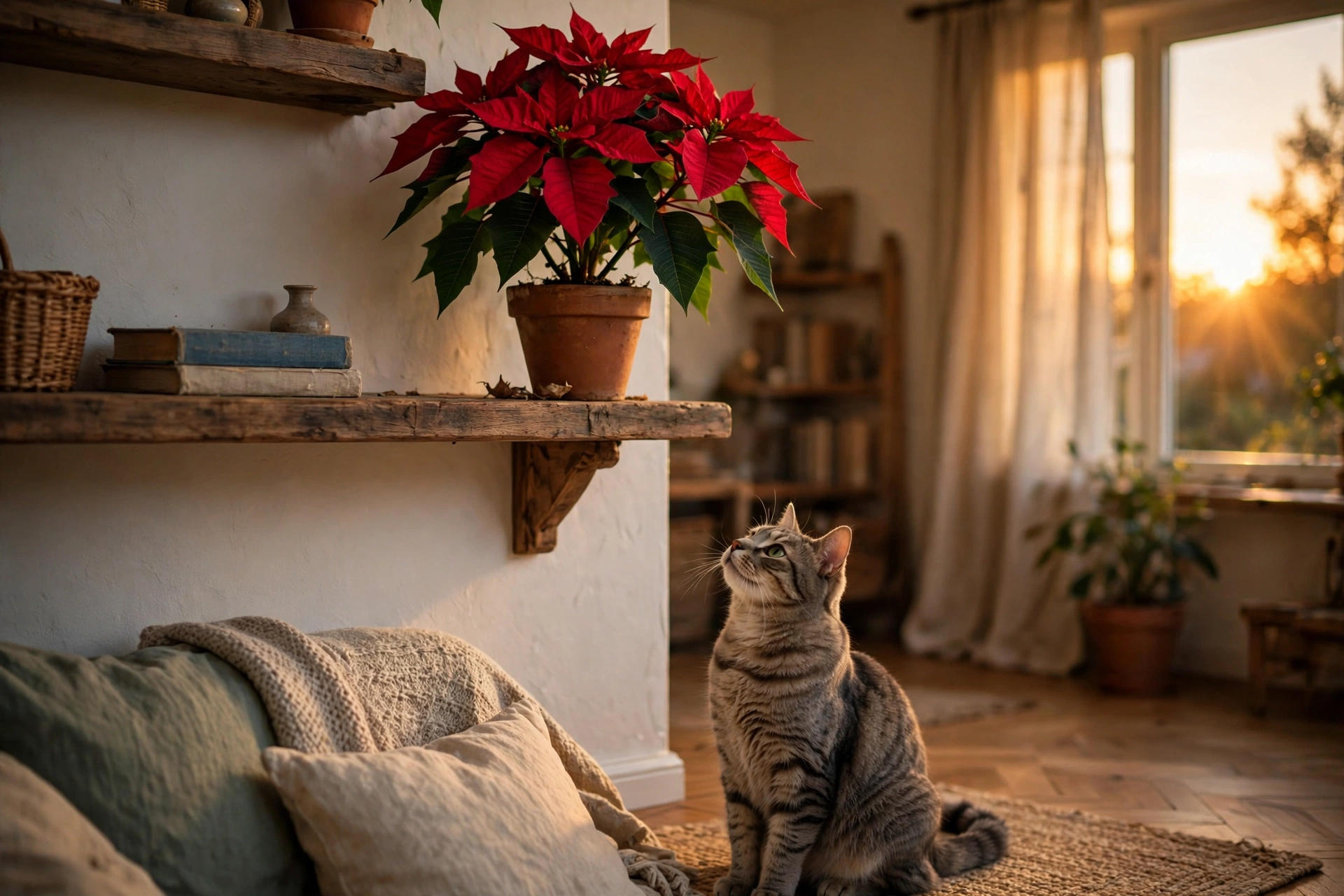
That does not mean poinsettias are harmless, or that pets should eat them. In a home with pets or small children, the sensible approach to poinsettia plant care is simple: keep the plant out of easy reach — on a table or shelf, not the floor — and do not let anyone chew the leaves. If a stem breaks, the milky sap can irritate skin, so wash your hands after handling it. You do not need to banish the plant, or panic if a cat takes one experimental bite. Keep it up high, keep an eye on it, and enjoy it.
After Christmas: What to Do With It in January
Most poinsettias are thrown away in January, and there is no shame in that — they were bought as a seasonal display, and six good weeks is a job done. But if you would like to keep yours, here is the short version. This is a summary, not the full guide — the full “how to care for a poinsettia after Christmas” routine deserves its own article later.
Once the bracts fade, poinsettia plant care gets simpler: cut back on watering, and do not feed it. In spring, prune the stems back by about a third, and water normally again as new growth appears. Grow it on through summer in bright light, feeding lightly every few weeks, and pinch the tips to keep it bushy rather than leggy.
Reblooming for Next Christmas: The October Darkness Routine
If you keep your poinsettia through the year, you can get it to colour again — but only for next Christmas. In poinsettia plant care, the rebloom routine starts in early October 2027, and it is strict: about 14 hours of complete darkness every night, for eight to ten weeks, with about 10 hours of bright light by day. Any light leak prevents the colour from forming — even a lamp on for a few minutes can undo a night’s darkness.
The usual method is to put the plant in a dark cupboard, or cover it with a light-proof box, from about 5pm to 7am each night, and bring it back into bright light each morning. Do this every night, without missing one, from early October until the colour shows — usually late November or early December. The University of Maryland Extension’s poinsettia guide describes the same routine: 14 hours of darkness daily, 5pm to 7am, through Thanksgiving, with even a small light leak preventing flowering. It is a fiddly routine, and the reason most people buy a new poinsettia each year rather than reblooming the old one — a fair choice. But if you enjoy a project, poinsettia plant care through the year ends with a satisfying payoff: a plant you kept alive for twelve months, turning red again. Either way, do not start the darkness routine in December and expect colour by Christmas — it is already too late for this year.
Frequently Asked Questions
How often should I water my poinsettia?
There is no fixed schedule that works for every home — that is the first thing to understand about poinsettia plant care. Water when the surface feels dry about an inch down, and check every two or three days. As a rough guide, most poinsettias in a heated room need water every five to eight days in winter, but pot size, warmth, and light change that. Water thoroughly, drain completely, and empty the saucer. Never leave the plant standing in water.
Why are my poinsettia leaves falling off?
Leaf drop usually means too much water, too little water, or cold or heat stress — the first symptom is the same in all three cases. If the soil is wet for days and the pot feels heavy, you are overwatering: stop, let it dry, and empty the saucer. If the soil is bone-dry and the pot feels light, water it thoroughly. If the plant is near a door, radiator, or cold window, move it somewhere warm and stable — the diagnosis table above is the quickest tool in poinsettia plant care for a dropping plant.
Can I keep my poinsettia alive after Christmas?
Yes — and poinsettia plant care after Christmas is simpler than most people expect. After the bracts fade, cut back watering, prune the stems by about a third in spring, and grow it on through summer in bright light with light feeding. To turn red again, it needs the October darkness routine — 14 hours of complete darkness every night for eight to ten weeks from early October — so reblooming is a project for next Christmas.
Are poinsettias poisonous to cats and dogs?
They are only mildly toxic, and their reputation is greatly exaggerated — the pet-safety question in poinsettia plant care has a reassuring answer. The ASPCA lists poinsettia as toxic to dogs and cats but calls it “generally over-rated in toxicity,” and Pet Poison Helpline rates it “only mildly toxic.” A pet that chews a leaf may drool or vomit mildly, and the milky sap can irritate skin. Keep the plant out of reach, do not let pets chew the leaves, and call your veterinarian if symptoms appear. The claim that poinsettias are deadly poisonous is false.
How much light does a poinsettia need?
Bright, indirect light for at least six hours a day is the light rule in poinsettia plant care. A spot near a south-, east-, or west-facing window is ideal, and a few hours of gentle winter sun is fine. Too little light makes the plant leggy and fades the red bracts — and a ceiling lamp is no substitute for real daylight.
Will my poinsettia turn red again by itself?
No — not without help. A poinsettia only recolours after eight to ten weeks of long, completely dark nights starting in early October, with bright light by day. A plant in a normally lit living room through autumn will stay green, because even a lamp in the evening breaks the darkness it needs. For red bracts next Christmas, start the darkness routine in October 2027: cover the plant, or put it in a dark cupboard, from about 5pm to 7am every night, without missing one — that is the rebloom rule in poinsettia plant care.
Final Word
Good poinsettia plant care is not complicated, but it is specific: bright light, water only when the surface is dry, drain fully, keep it warm and out of draughts, take the foil off, and do not feed it while it is in bloom. Most poinsettias that fail in December fail on one of those six things — and most of them fail on water, because the plant was watered on a schedule instead of being checked.
Buy from a warm display, wrap it for the journey home, and give it a bright, steady spot. Keep it there, check the soil every few days, and enjoy it — that is poinsettia plant care, done well. That is the whole of poinsettia plant care for the holidays: a little attention, applied consistently, and a plant that stays bright until the decorations come down. And if you keep it past Christmas, you already know the one thing that matters most — the colour comes back next year, in October, in the dark.
Further reading: Pet Poison Helpline’s Poinsettia page and the University of Maryland Extension’s Poinsettias guide.