Yes, you can grow carrots in a pot. Pick the right variety, give the roots loose soil and enough depth, and container gardening carrots can taste just as sweet as carrots from a garden bed — unless the soil is heavy, the pot shallow, or young roots are handled roughly.
This guide also covers the gaps most guides skip — pot sizes, soil temperature, fixing forked or bitter roots, and cold protection — plus our potato container gardening and cucumber container gardening guides, the second published today.
Why container gardening carrots works so well
Carrots suit pots because you control the soil completely: in the ground, clay, stones, and compacted earth are the usual reasons carrots come out forked or bent, while a container starts with loose, stone-free potting mix — the biggest advantage of container gardening carrots over ordinary garden soil.
Containers are also movable: carrots need six to eight hours of direct sun, and a pot can be shifted to follow it — and they let you garden with no bed at all. The limits are real: a pot dries out and freezes faster than the ground, and one pot will never match a garden row. But for fresh, sweet carrots, container gardening carrots is one of the most rewarding small-space crops you can grow.
Pick a variety that fits your pot
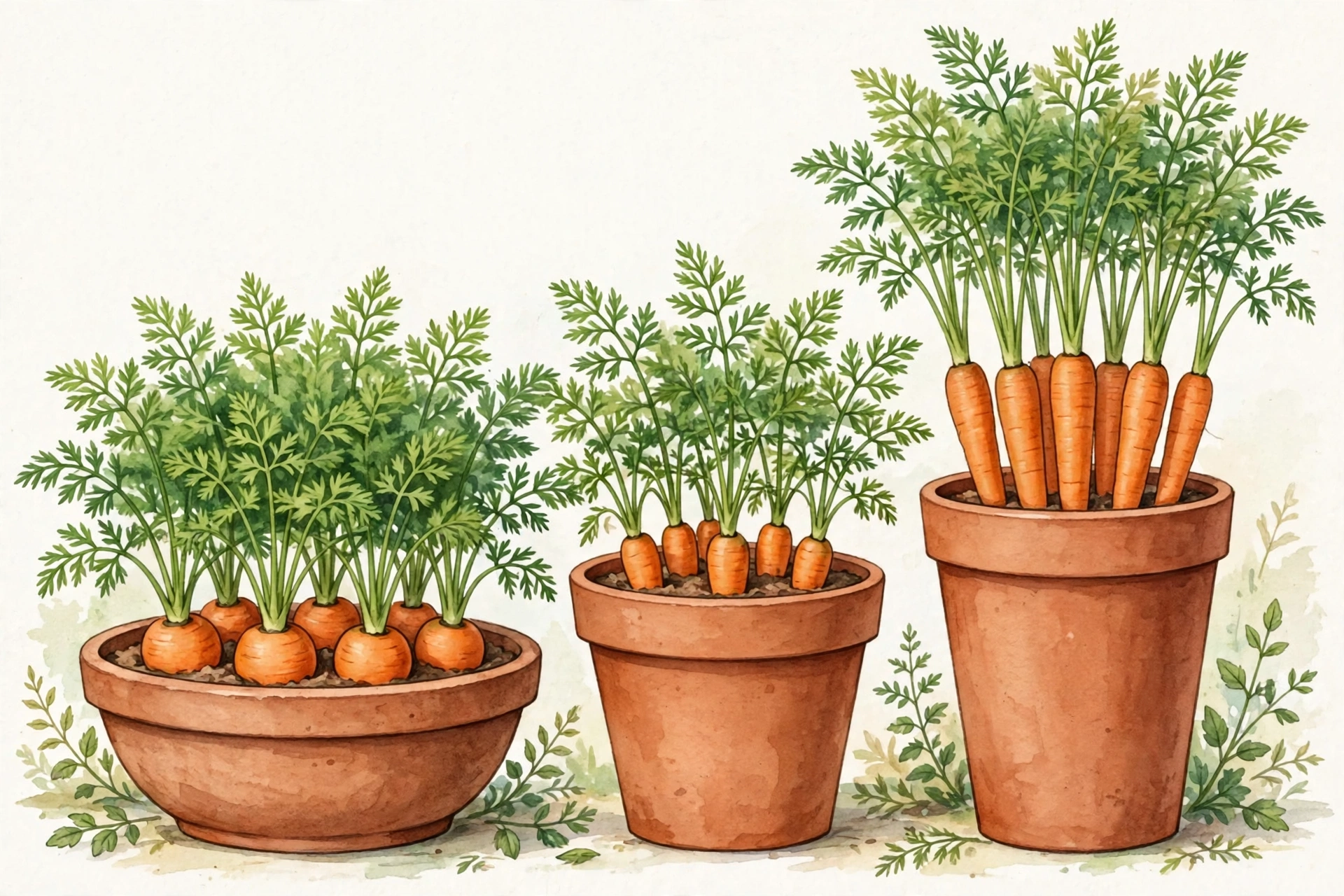
Most people go wrong here: they sow long carrots in a shallow pot and wonder why roots come out short or bent. Long varieties need deep soil; short and round types suit most pots.
| Variety | Root | Days to harvest | Min. pot depth |
|---|---|---|---|
| Parisian Market / Tonda di Parigi (round) | 1–2 in round | 50–60 | 6–8 in |
| Thumbelina (round) | 1–2 in round | ~55–60 | 6–8 in |
| Little Finger | ~3 in | ~55 | 6–8 in |
| Nantes (incl. Scarlet Nantes) | 6–7 in, blunt tip | 60–70 | 10–12 in |
| Chantenay / Red Cored Chantenay | 5–6 in, broad shoulder | 65–70 | 10–12 in |
| Danvers | 6–8 in | ~70 | 16–18 in (deep pot only) |
| Imperator types | 8–9 in | 68–75 | 18 in+ — say plainly: not for small pots |
For a first try, choose a round type such as Parisian Market or Thumbelina, or a short Nantes type — forgiving, fairly quick, and sized for pots most people own. Little Finger is another good beginner choice at only about three inches long. But note the last two rows: Danvers needs a pot at least 16 to 18 inches deep, and Imperator types need 18 inches or more — not small-pot carrots. With a standard 12-inch pot, choose a shorter variety and your container gardening carrots will come out straight.
Which pot size do you need — and how many carrots fit?
Once you know your variety, the pot choice is straightforward — but these are estimates; spacing, variety, and thinning all matter.
| Container | Best varieties | Roughly how many carrots |
|---|---|---|
| 12-inch round pot (about 5 gallons) | Little Finger, Nantes, Chantenay | About 16 plants in a 12-inch-square area |
| 5-gallon bucket (about 12 inches wide, 14–15 inches deep) | Nantes, Chantenay, Little Finger | Roughly 12–16 plants, thinned to 2 inches apart |
| 7–10-gallon grow bag | Nantes, Chantenay, Parisian Market, Thumbelina | Roughly 16–24 plants, depending on width |
| Window box (at least 8 inches deep) | Parisian Market, Thumbelina, Little Finger | A single row or two short rows, thinned to 2 inches apart |
Square-foot gardening guidance gives the one firm number here: a 12-inch-square container holds about 16 plants. Thin to two inches apart — crowded container gardening carrots stay thin and fork more easily. Whatever you choose, it must have drainage holes; carrots in waterlogged soil will rot, so drill holes if there are none. Depth matters more than width, but a wider pot gives more plants.
The right soil mix for container gardening carrots
Do not use garden soil in a pot — it compacts, holds too much water, and often contains stones that split young roots. For container gardening carrots, you want a mix that stays loose, drains freely, and holds just enough moisture to keep the surface damp while seeds germinate.
A simple mix is good potting mix with added sand or perlite and a little mature compost — structure, drainage, and gentle nutrition without heavy nitrogen that pushes leafy tops over roots. Sieve out lumps, sticks, and stones first: anything hard near the top can deflect a young root. Aim for pH 6.0 to 6.8, fill to an inch below the rim, water well, and let it drain before sowing.
Feed your container gardening carrots lightly: they need very little fertiliser, and too much nitrogen gives lush tops and poor roots. Use a low-nitrogen feed only, about once every three to four weeks; bone meal at planting can support roots, but keep it modest.
When to sow: soil temperature matters more than the calendar
Every guide says carrot seeds take 14 to 21 days to germinate — true, but germination speed depends on soil temperature, and the difference is large enough to change your plans for container gardening carrots.
| Soil temperature | Germination time | What to expect |
|---|---|---|
| 60–70°F (15–21°C) | 7–14 days | Optimum range — fastest, most even germination |
| 50–60°F (10–15°C) | 14–21 days | Slower, but usually fine |
| 45–50°F (7–10°C) | 21–28 days | Slow and patchy — some seeds may not come up at all |
| Above ~75°F (24°C) | Inhibited | Germination slows or stops — wait for cooler weather |
Sow into cold soil and nothing may appear for three weeks — the seeds may not be dead, just slow. Sow in midsummer heat and the soil may simply be too warm. If nothing has sprouted by day 21, reseed, checking soil temperature first. For a steady supply, sow a small batch every two to three weeks — succession sowing gives fresh container gardening carrots over a longer period rather than one glut.
How to sow carrot seeds in a container
Carrots must be sown directly where they will grow — never start them in trays and transplant them, as transplanting disturbs the young taproot and disturbed roots fork. For container gardening carrots, direct sowing is not optional.
- Fill and water the pot. Fill with the loose mix above, to an inch below the rim, water well, and let it drain.
- Make shallow rows. Draw furrows a quarter of an inch deep, rows two inches apart.
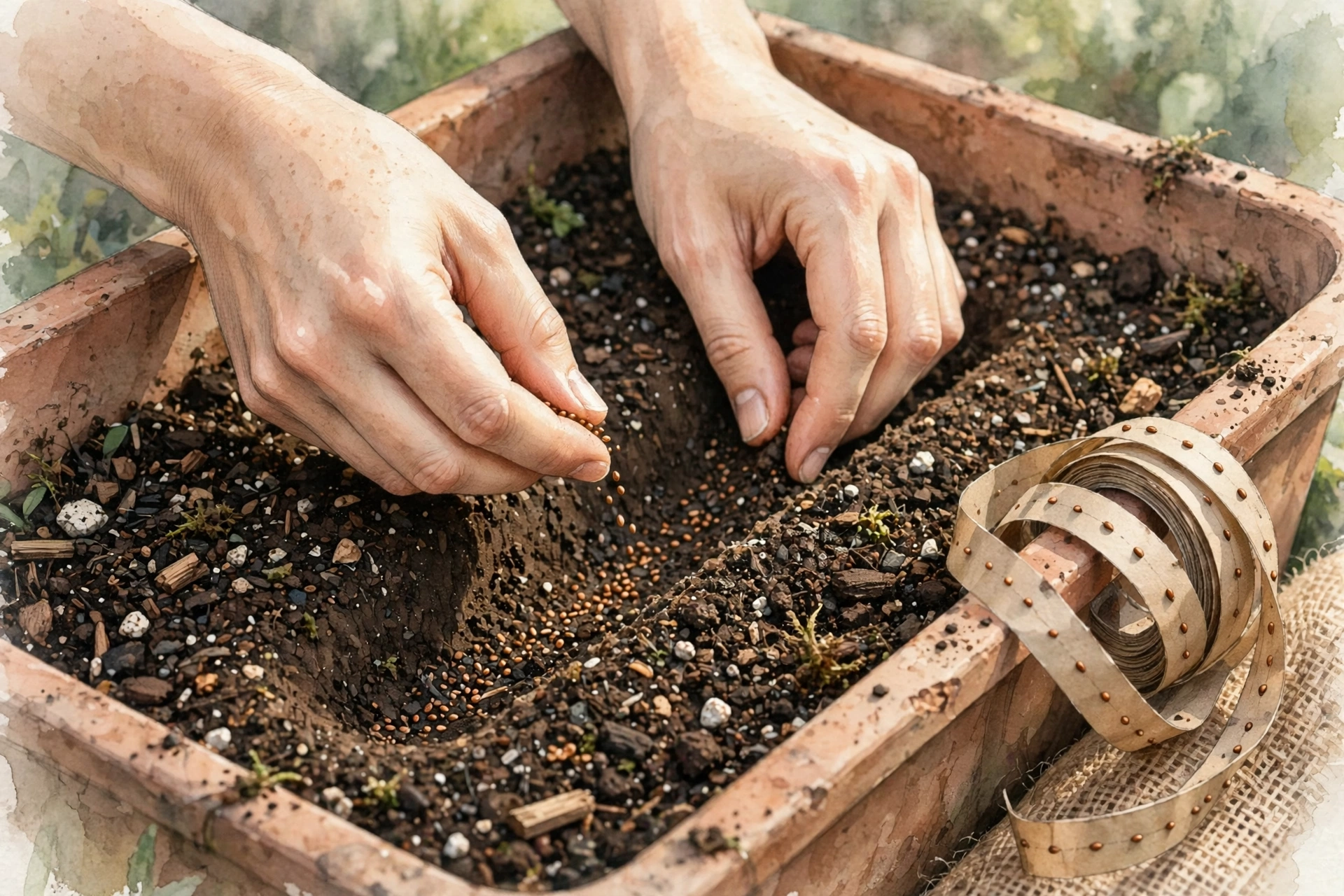
- Sow thinly. Scatter seeds as thinly as you can — you will thin later.
- Cover lightly. Cover with a fine sprinkle of mix or vermiculite, no more than a quarter of an inch deep, and mist gently — a hose blast will wash seeds away.
- Keep the surface moist. Seeds need consistent surface moisture for two to three weeks — if the top dries out, germination stalls. Water lightly and often, and cover with burlap or a board for the first week, lifting it daily.
- Wait. Seedlings appear in seven to fourteen days at the optimum temperature, or fourteen to twenty-one in cooler soil. Do not dig up the row to check.
Seed tapes and pelleted seed make sowing easier
If tiny seeds frustrate you, try a fix most guides never mention: seed tapes — biodegradable paper strips with seeds already spaced along them, laid in the furrow, covered, and watered in — or pelleted seeds, coated in a clay pellet large enough to handle. Both cost a little more than loose seed but save much thinning and even out spacing — a genuine advantage for container gardening carrots, where every plant counts.
Thinning: snip, don’t pull
Thinning is the step most beginners skip, and it makes the biggest difference to root size: sown thinly, carrots still come up too close together. Thin your container gardening carrots to a final spacing of about two inches apart.
Thin first at the cotyledon stage — about an inch tall, still showing the first smooth seed leaves, before the feathery true leaves tangle. Then snip, don’t pull: cut unwanted seedlings off at soil level with small scissors. Pulling disturbs the soil around the keepers and can damage young roots. Thin in two stages if needed, and water gently afterwards.
Watering, sun, and feeding
Carrots in containers need steady, even watering: keep the top six inches moist, and water your container gardening carrots when the top two inches feel dry. Wet-and-dry swings cause cracking and forking — the root grows fast after watering, then stalls as the soil dries, and the skin splits. Terracotta and fabric grow bags dry out faster than plastic or glazed pots, so check them more often in warm weather; a thin mulch helps hold moisture.
Give your container gardening carrots six to eight hours of direct sun a day, shifting the pot if one corner loses sun by mid-afternoon. Light shade at midday is fine, but deep shade gives leafy tops and thin roots. Feed lightly — low-nitrogen, about once every three to four weeks.
Companion planting in the same container
Carrots do not have to grow alone: a few well-chosen companions make good use of the space around slow-growing container gardening carrots.
- Radishes as row markers. Radishes germinate fast and break the soil crust, helping seedlings push through. Sow a few at the end of each row to mark it, and harvest them early.
- Spring onions. They take up little space and grow upright — a good edge-of-pot companion.
- Lettuce at the edge. Loose-leaf lettuce around the edge of a large pot shades the soil and keeps it moist — harvest outer leaves regularly.
Scented herbs and alliums may confuse pests, but keep them modest — a large herb plant competes for water and space. What not to plant matters too: avoid other root crops competing for the same soil, and large, hungry plants that shade carrots out or drink the pot dry. Dill is often listed as a poor companion, and parsnips share pests and compete in the same root zone, so keep them separate. Future articles here will cover companion plants for carrots in more depth.
Troubleshooting: what went wrong and how to fix it
Things can still go sideways — this table covers the commonest problems with container gardening carrots, the likely cause, and the fix.
| Problem | Likely cause | Fix |
|---|---|---|
| Forked or split roots | Stones, lumps, or compacted soil deflecting the young root; transplanting; rough thinning | Use stone-free, loose mix; never transplant; snip, don’t pull, when thinning |
| Cracked or split roots | Uneven watering — wet/dry swings | Water evenly; keep top 6 inches moist; mulch the surface lightly |
| Green shoulders | Sunlight reaching the top of the root | Hill soil up over the shoulders as they appear; keep the crown covered |
| Bitter taste | Stress, heat, or leaving roots in the ground too long; too much nitrogen | Water evenly; harvest at the right time; feed low-nitrogen only |
| No germination | Soil too cold or too hot; seeds sown too deep; surface dried out | Check the soil-temperature table; sow 1/4 in deep; keep surface moist; reseed after 21 days |
| Leggy seedlings | Not enough light | Move the pot to a sunnier spot (6–8 hours direct sun); thin so seedlings are not shading each other |
| Carrot fly | Adult flies laying eggs at the base of plants; larvae tunnel into roots | Cover with horticultural fleece, or raise the pot on a table — carrot flies are poor fliers and rarely fly that high |
On green shoulders: sunlight turns the exposed top green and bitter, so hill soil over shoulders as they show. On carrot fly: the adult is a weak flier that stays low, so raising your pot on a table puts plants above its usual height, and horticultural fleece adds a barrier while letting light and water through. For the standard steps this article builds on, see the Epic Gardening guide to container carrots and the Almanac guide to growing carrots in containers.
Harvesting your container gardening carrots
Most varieties are ready 60 to 75 days after sowing — round types first, at around 50 to 60 days, Nantes and Chantenay at 60 to 70. Do not pull the whole pot on the calendar alone: test-pull one carrot, checking size, colour, and taste, and if it is still thin, wait a week and test again. Left too long past their prime, carrots go woody and lose sweetness, so harvest your container gardening carrots when they are ready.
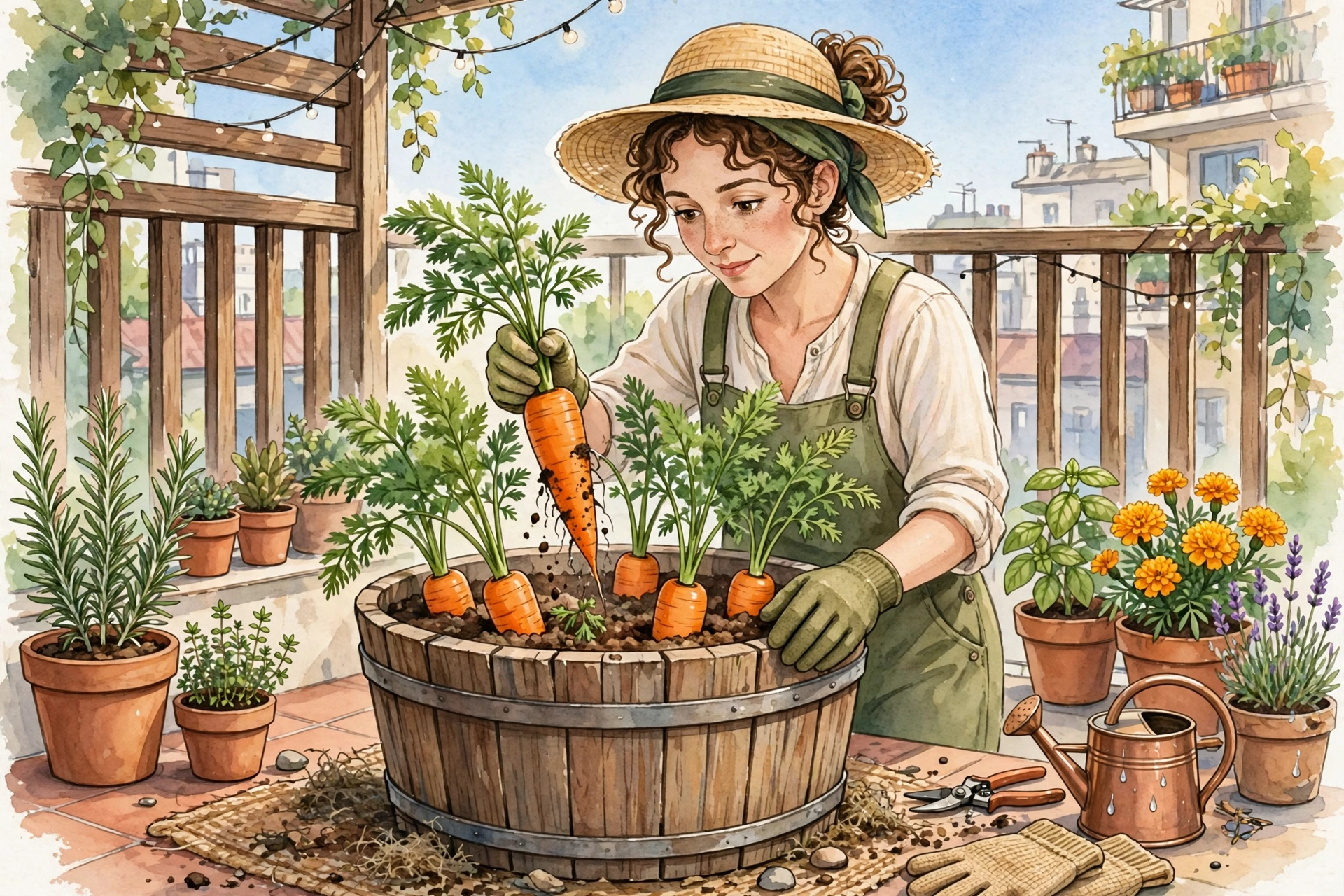
To harvest your container gardening carrots, water lightly an hour beforehand so the soil is damp and loose, then pull each carrot straight up with a gentle twist; if a root resists, loosen the soil with a hand fork rather than yanking.
Storing carrots so they stay sweet
Remove the tops before storing: they keep drawing moisture from the root, so carrots stored with tops on go limp quickly. Twist or cut them off, leaving half an inch of stem, as soon as you harvest your container gardening carrots.
Store your container gardening carrots unwashed in the fridge — washing removes the thin protective layer on the skin and shortens their life, while unwashed carrots keep for weeks longer — in a perforated bag or a container with a damp cloth, in the crisper drawer. Do not leave mature carrots in the pot past their prime: they go woody and lose sweetness, so empty a finished pot, refresh the mix, and sow again.
Pots freeze faster than garden soil — plan for cold
A gap most guides skip: a container freezes faster than garden soil, because pot soil is exposed to cold air on all sides. A light frost can sweeten container gardening carrots, but a hard freeze can damage roots that would have survived in the ground.
If a hard freeze is forecast and your container gardening carrots are not ready, move the pot somewhere sheltered — a south-facing wall, unheated greenhouse, cold frame, or garage for the worst nights — wrap it in bubble wrap or hessian, and mulch thickly on top. For overwintering late-sown carrots, a sheltered spot plus fleece is usually enough in a mild climate, but in a hard winter harvest before the coldest weather rather than gambling on the pot.
Budget and reused containers for container gardening carrots
You do not need an expensive ceramic pot: some of the best containers for container gardening carrots are cheap or free — a 5-gallon bucket, a storage tote, or a 7- to 10-gallon fabric grow bag, deep enough for your variety and with drainage holes. Grow bags are a particularly good choice: light, free-draining, and the fabric lets air reach the roots.
Pricey ceramic pots look lovely, but they are heavy, hard to move, and many have poor drainage — check before sowing and drill extra holes if needed. Whatever you reuse, check the plastic is food-safe, and avoid containers that once held chemicals, paint, or anything you would not want near food. Food-grade buckets and totes are usually marked. Drill holes in the base, plus a couple low on the sides if the base sits flat, and raise the pot on feet or bricks so water drains freely.
Frequently asked questions
How deep does a pot need to be for container gardening carrots?
Round types such as Parisian Market and Thumbelina need only 6 to 8 inches, as does Little Finger. Nantes and Chantenay need 10 to 12 inches; Danvers needs 16 to 18, and Imperator types 18 or more, so they are not suitable for small pots.
How long do carrots take to grow in a container?
Most varieties take 60 to 75 days from sowing; round types are faster, at 50 to 60 days, and Little Finger is ready in about 55 days. Germination alone takes 7 to 21 days depending on soil temperature, so count from the day you sow — the same whether your container gardening carrots are on a balcony or a patio.
Why are my container carrots forked?
Forked roots are usually caused by stones, lumps, or compacted soil deflecting the young root, or by transplanting or rough thinning. Use a loose, stone-free mix, sow directly, never transplant, and thin by snipping at soil level instead of pulling.
How many carrots can I grow in a 12-inch pot?
A 12-inch-square container holds about 16 plants, thinned to two inches apart; a 5-gallon bucket roughly 12 to 16, and a 7- to 10-gallon grow bag roughly 16 to 24, depending on width — the working figures for container gardening carrots in standard pots.
How often should I water carrots in pots?
Keep the top six inches evenly moist, watering when the top two inches feel dry. Terracotta and fabric grow bags dry out faster than plastic or glazed pots. Even watering matters more than frequent watering — wet and dry swings cause cracking and forking in container gardening carrots.
Can I grow carrots in a container in winter?
You can grow them in cool weather, and a light frost can sweeten the roots, but a container freezes faster than garden soil. In a hard freeze, move the pot somewhere sheltered, insulate it, or harvest first. For overwintering container gardening carrots, a sheltered spot with fleece works in a mild climate, but harvesting before a hard winter is safer.
Do carrots need full sun in containers?
Yes — six to eight hours of direct sun a day is ideal, and containers can be moved to follow it, one advantage of container gardening carrots. Light shade at midday is fine, but deep shade gives thin roots and leafy tops.