Why grow cucumbers in containers?
You do not need a large vegetable plot to grow cucumbers. A single plant in a large pot on a sunny patio, balcony or deck can produce a steady supply of crisp fruit through summer. In cucumber container gardening, three things matter most: a big enough container, consistent watering and support for the vines.
Cucumber container gardening has practical advantages. You control the soil mix from the start, you can move the pot to follow the sun or shelter it from strong wind, and you avoid many soil-borne problems that build up in garden beds. For renters and anyone with limited outdoor space in the USA, UK, Canada or Australia, it is often the easiest way to grow cucumbers at home. The same container principles work for other vegetables too — see our guide to potato container gardening for another beginner-friendly crop.
Cucumbers are warm-season, fast-growing plants. They are not frost-tolerant, and they grow best once days are warm and nights stay reliably above 50°F (10°C).
Best cucumber varieties for containers
Start with the variety, because in cucumber container gardening it decides the pot size and the support you need.
Bush and compact varieties stay shorter and are the simplest choice for pots and small balconies. Look for varieties described as bush, compact, patio or container types on the seed packet. Commonly available examples include:
- Spacemaster — a compact vining type bred for small spaces, suitable for a large pot with a short trellis
- Bush Champion — a bush slicing cucumber, compact and productive in a 5-gallon container
- Patio Snacker — a compact type producing small, snack-sized fruit, well suited to containers
- Bush Pickle — a compact pickling type for smaller pots
Vining varieties produce longer vines and usually a heavier crop, but they need a larger container and a sturdy trellis, obelisk or railing to climb. Standard slicing and pickling varieties sold for garden beds will grow in containers if you give them that extra space and support.
If this is your first attempt at cucumber container gardening, choose a bush or compact variety. It is more forgiving on watering, easier to support, and less likely to outgrow a balcony.
Check the seed packet for days to harvest, fruit size and whether the variety is described as suitable for containers. That information is more reliable for your local conditions than a general list, as variety availability differs between the USA, UK, Canada and Australia.
Choosing the right container
Pot size is the most common reason container cucumbers struggle — and the first thing to get right in cucumber container gardening. Cucumbers develop an extensive root system and drink a lot of water, so a small pot dries out quickly and restricts growth.
Use these minimums as a guide:
| Plant type | Minimum container | Better choice |
|---|---|---|
| Bush / compact | 5 gallons, at least 12 inches deep | 5–7 gallons |
| Vining | 10 gallons | 10–15 gallons |
In cucumber container gardening, grow one cucumber plant per container. Crowding two plants into a minimum-size pot leads to competition for water and nutrients and makes both plants less productive.
Whatever material you choose — plastic, fabric grow bag, terracotta or a 5-gallon bucket — the container must have drainage holes in the base. Good drainage is non-negotiable in cucumber container gardening. Cucumbers need constant moisture, but they do not tolerate sitting in waterlogged mix. Raise the pot slightly on feet or a stand so water can drain freely, and empty any saucer after watering.
Fabric grow bags are a popular choice for cucumbers because they drain well and are easy to store after the season. Terracotta looks attractive but dries out faster than plastic, so it needs more frequent watering in hot weather.
Soil mix for container cucumbers
Do not fill a container with garden soil for cucumber container gardening. In a pot, garden soil compacts, drains poorly and can carry pests and diseases. Use a high-quality potting mix made for containers or vegetables instead.
A simple, reliable approach is:
- Two parts quality potting mix
- One part compost
- A handful of perlite mixed through, if your potting mix is heavy and holds too much water
This gives you a mix that holds moisture without becoming soggy, with compost adding nutrients and structure — exactly what cucumber container gardening needs. Cucumbers grow best in a slightly acidic to neutral mix, around pH 6.0 to 6.8, which most commercial potting mixes already fall within.
Fill the container to about 1 inch below the rim. That gap stops water and mix washing over the edge when you water. Moisten the mix thoroughly before sowing or transplanting, so it is evenly damp rather than dry in the centre.
At planting time, mix in a slow-release fertiliser formulated for vegetables, following the rate on the product label. Do not add extra fertiliser beyond the label rate — more is not better and can damage young roots.
When and how to plant cucumbers in pots
Cucumbers need warmth to germinate and grow. In cucumber container gardening, wait until all danger of frost has passed, nighttime temperatures stay consistently above 50°F (10°C), and the mix in the pot has warmed to at least 60°F (about 16°C). In most temperate regions, that is about two weeks after the last spring frost date. Planting into cold mix is a common cause of slow germination and weak seedlings.
You can sow seed directly in the final container, or start cucumber container gardening with a young transplant bought or raised indoors.
Sowing seed directly:
- Sow 2 to 3 seeds per container, about 1/2 inch deep.
- Water gently and keep the mix consistently moist until germination.
- Once seedlings have their first true leaves, thin to the single strongest plant and remove the others at soil level.
Planting a transplant:
- Water the transplant in its original pot first, so the root ball holds together.
- Make a hole in the centre of the container the same depth as the root ball.
- Set the plant in at the same level it was growing before — do not bury the stem deeper.
- Firm the mix gently around it and water thoroughly until water runs from the drainage holes.
Handle cucumber roots carefully. Cucumbers dislike root disturbance, which is why direct sowing in the final pot often works as well as transplanting for cucumber container gardening.
Sunlight, position and trellis support
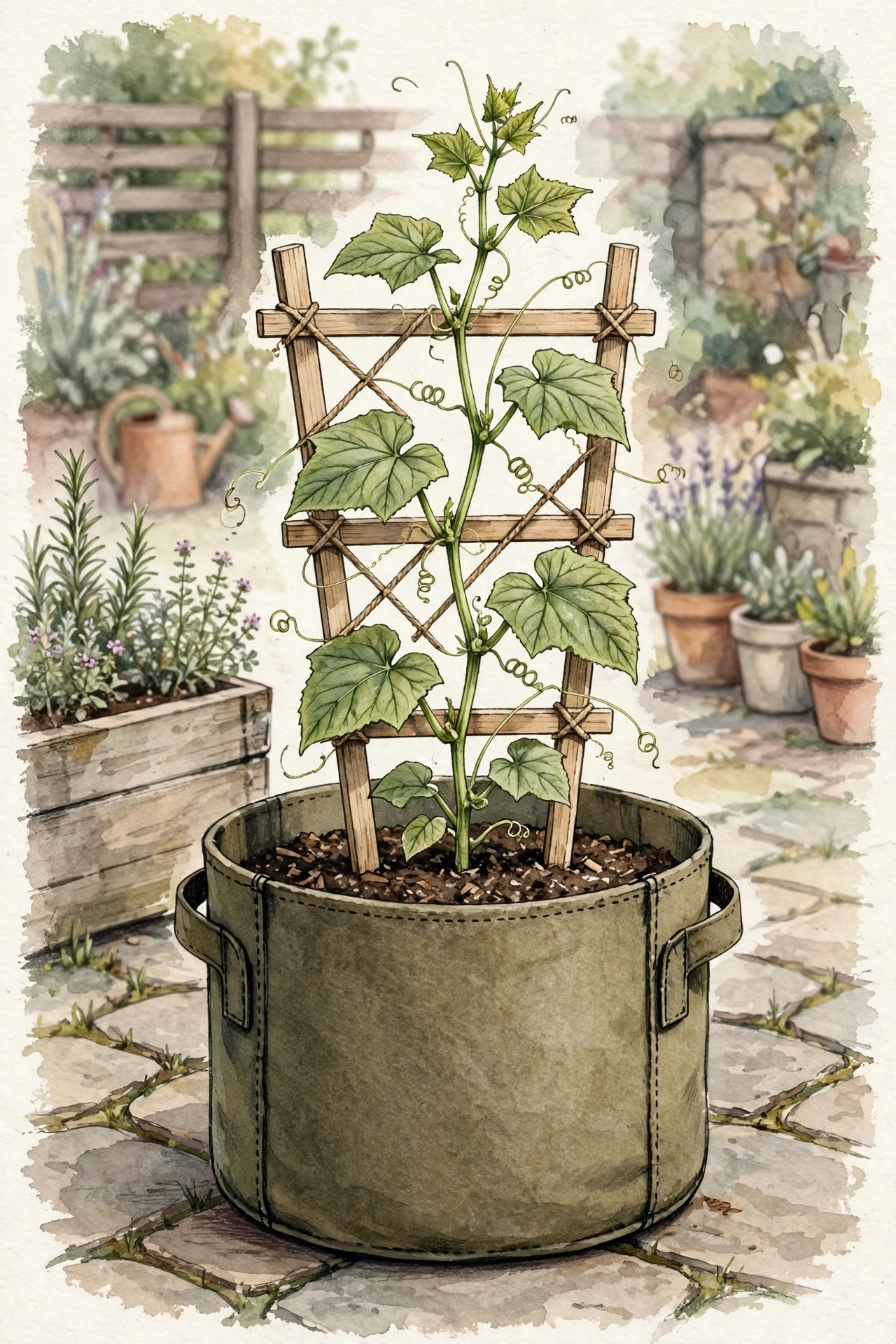
Place the container where it will receive at least 6 to 8 hours of direct sunlight a day. More sun means stronger growth and better fruiting in cucumber container gardening, provided you keep up with watering. A sheltered, sunny spot against a wall or fence also protects the vines from strong wind, which can damage leaves and dry the pot out faster.
Even bush varieties benefit from some support in cucumber container gardening. For vining varieties, support is essential:
- Install the trellis, obelisk, cage or netting at planting time, so you do not disturb roots later.
- Make sure the support is sturdy and the pot cannot topple once the vine is heavy with fruit. On a balcony, tying the support to a railing helps.
- Guide young tendrils onto the support as they grow. Once they grip, the plant will mostly climb on its own.
Growing vertically in cucumber container gardening saves floor space, keeps fruit clean and off the mix, improves air circulation around the leaves, and makes harvesting easier. Better airflow also helps reduce leaf disease.
Watering container cucumbers
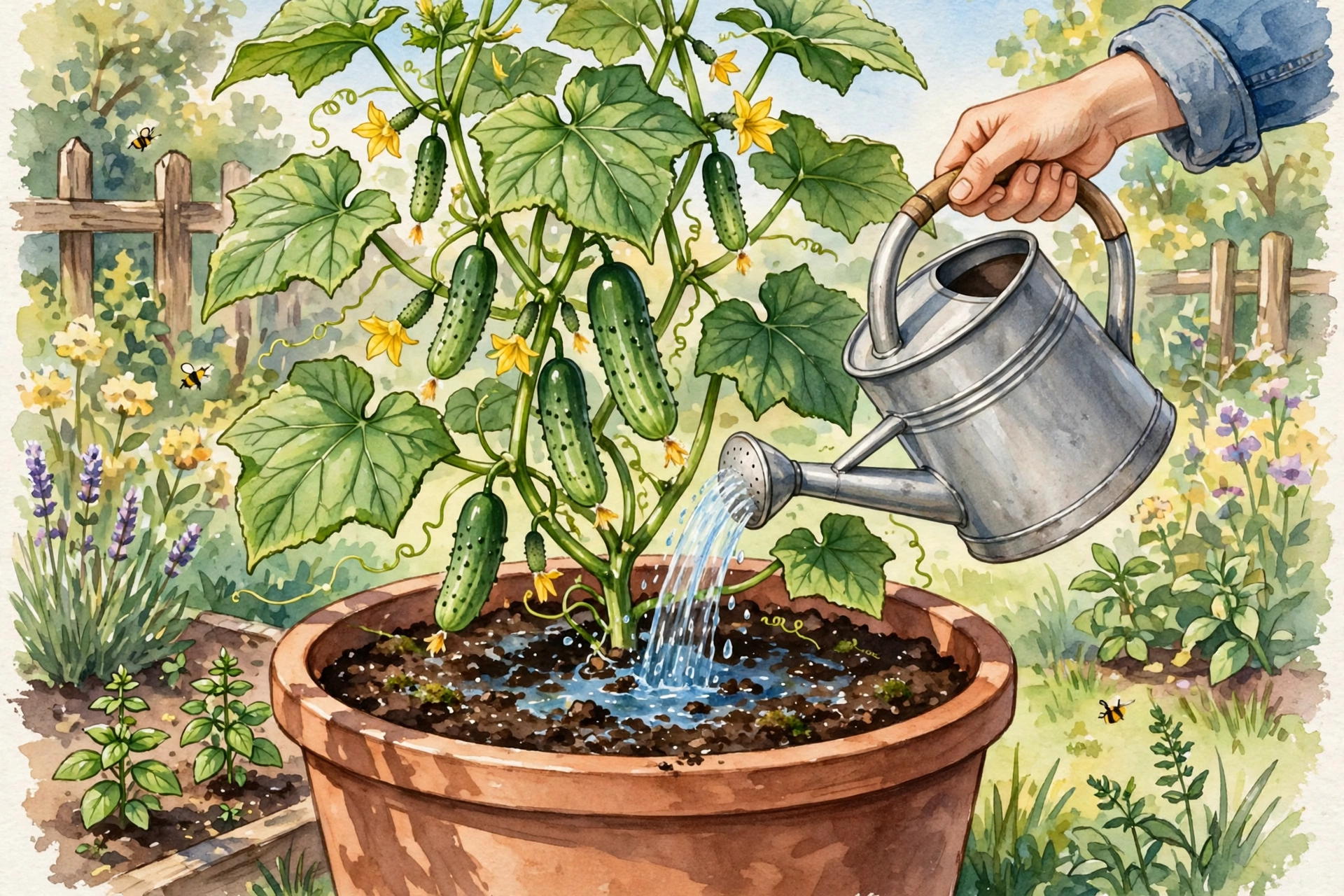
Watering is where cucumber container gardening most often goes wrong. Pots dry out much faster than garden beds, and cucumbers need consistent moisture, especially once flowers and fruit form. Irregular watering — letting the pot dry out, then soaking it — can lead to bitter, misshapen or hollow fruit.
In cucumber container gardening, use moisture, not a fixed calendar, as your guide:
- Check the mix daily in warm weather by pushing a finger 1 to 2 inches into the surface. If it feels dry at that depth, water.
- Water thoroughly until water runs from the drainage holes, so the whole root ball is moistened.
- In hot summer weather, a container cucumber may need watering once a day, and a small pot in full sun may need a second check later in the day.
- Water at the base of the plant, in the morning where possible, and try to keep leaves dry. Wet foliage for long periods encourages disease.
- A layer of mulch on the surface of the mix, such as straw or shredded bark, helps slow evaporation in cucumber container gardening. Keep mulch a little clear of the stem.
Never let the pot dry out completely in cucumber container gardening. Very dry potting mix can pull away from the sides of the container, so water runs straight down the gap without soaking in. If that happens, water slowly, wait, and water again.
Feeding container cucumbers
Cucumbers are heavy feeders, and in cucumber container gardening nutrients wash out of containers faster than out of garden soil. The slow-release fertiliser added at planting covers the early weeks, but container plants usually need additional feeding once growth is strong and flowering begins.
Feed with a liquid fertiliser formulated for vegetables or fruiting plants, following the dilution and frequency on the label — commonly every 10 to 14 days during active growth and fruiting. Do not exceed the label rate.
Once fruit starts to set in cucumber container gardening, avoid very high-nitrogen feeding. Too much nitrogen encourages leafy growth at the expense of fruit. A balanced vegetable feed, or one made for fruiting crops, is the safer choice at that stage.
Yellowing leaves on an otherwise well-watered plant are often a sign the plant is hungry, especially in mid to late season. Check watering first, then feeding, before assuming disease.
Pollination in containers
Most standard cucumber varieties grown in cucumber container gardening produce separate male and female flowers and need pollinators — mainly bees — to transfer pollen. Outdoors on a patio or in a garden, this usually happens without help.
On a high balcony, in a very sheltered spot, or where you see small fruit forming then yellowing and dropping, pollination may be poor — a common frustration in cucumber container gardening. You can hand-pollinate:
- Identify a male flower — it grows on a thin stem. A female flower has a small swelling behind the petals, which is the immature fruit.
- Pick a freshly opened male flower in the morning, remove its petals, and dab its pollen directly onto the centre of a female flower. A small soft brush works as well.
Some modern varieties are parthenocarpic, meaning they set fruit without pollination, and some are described as all-female. Check the seed packet — if you are growing in a greenhouse, conservatory or a spot with few pollinators, a parthenocarpic variety is a practical choice.
Common pests, diseases and problems
Good spacing, airflow and watering at the base prevent many problems before they start in cucumber container gardening. Check the undersides of leaves regularly, so you spot issues early.
- Powdery mildew — white, powdery patches on leaves, common in warm, humid weather with poor airflow. Remove badly affected leaves, improve spacing and airflow, and avoid wetting the foliage when you water.
- Cucumber beetles — small striped or spotted beetles that feed on leaves and flowers. Pick them off by hand when numbers are low and keep the area around the pot clear of debris.
- Aphids — clusters on new growth and under leaves. Blast them off with a firm jet of water, or remove them by hand.
- Bitter fruit — most often linked to irregular watering, heat stress or letting fruit grow too large. Water consistently and harvest promptly.
- Fruit yellowing and dropping when small — often poor pollination or plant stress from dry mix. Hand-pollinate and check watering.
- Wilting in midday heat that recovers by evening — usually temporary heat stress in a pot. Check moisture first; if the mix is dry, water thoroughly and consider light afternoon shade in extreme heat.
Avoid reaching for a pesticide as a first step in cucumber container gardening. Correct identification matters, and product rules differ by country. For a specific pest or disease you cannot identify, your local extension service in the USA and Canada, or a local garden centre in the UK and Australia, can advise on options approved where you live.
When and how to harvest
Most cucumbers are ready to harvest 50 to 70 days after sowing in cucumber container gardening, depending on the variety, but the fruit itself is the better guide than the calendar. Harvest at the size described on the seed packet for that variety:
- Slicing cucumbers are usually picked when they are firm, evenly coloured and about 6 to 8 inches long, before seeds become large.
- Pickling cucumbers are picked smaller, typically 3 to 5 inches long.
- Snack and mini types are picked at the smaller size stated on the packet.
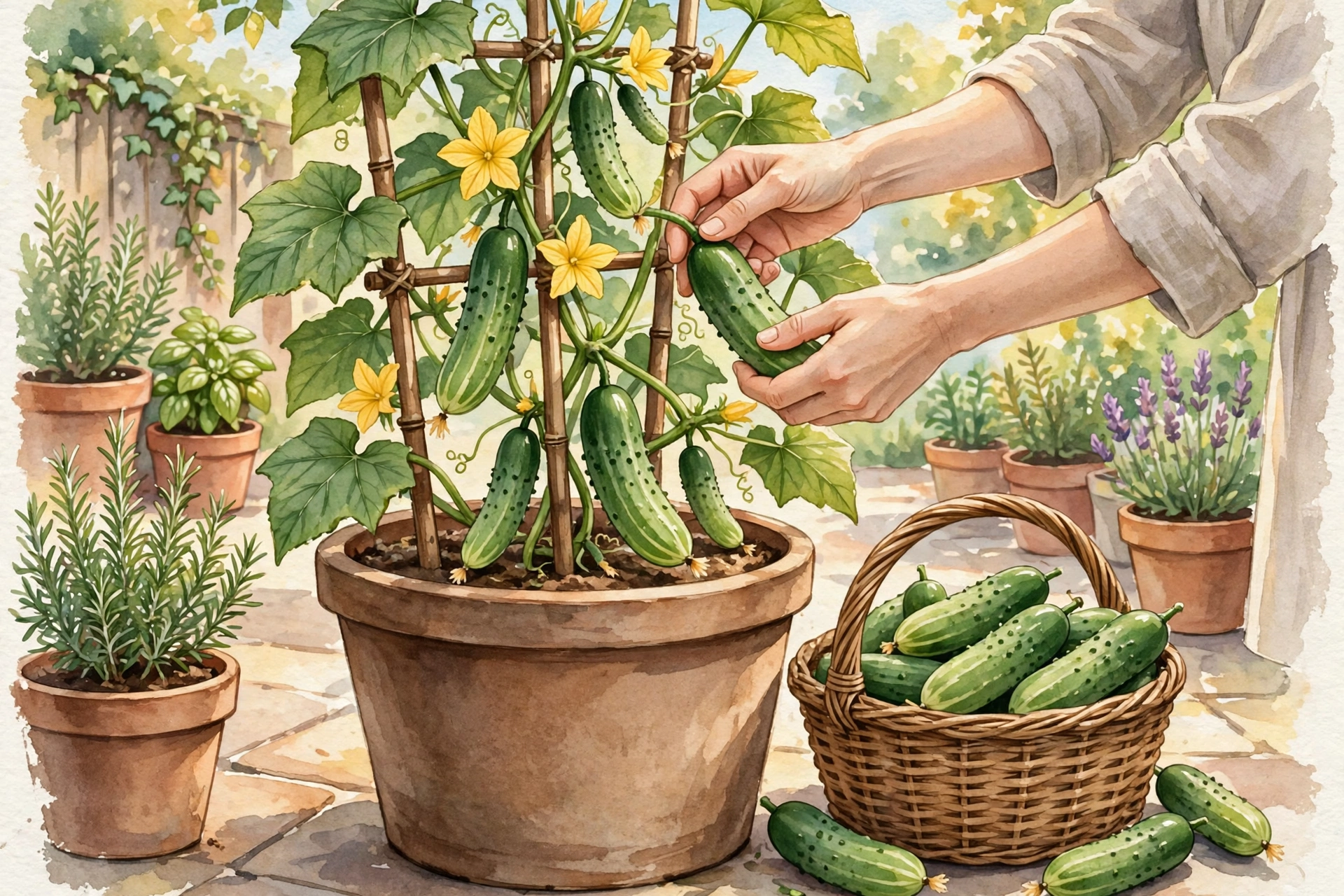
Pick early and often — in cucumber container gardening, regular picking keeps the plant producing. Leaving an overripe, yellowing cucumber on the vine signals the plant to slow production. During peak season, check plants every day or two.
Use scissors or pruners to cut the stem just above the fruit rather than pulling, which can damage the vine. Harvest in the morning when fruit is crisp, and use or refrigerate it promptly.
At the end of the season, remove the plant and spent mix from the pot. Do not reuse the same mix for cucumbers or related crops the following year without refreshing it substantially, as nutrients will be depleted and disease risk increases.
Frequently asked questions
How big a pot do I need for cucumber container gardening?
For cucumber container gardening, use at least a 5-gallon container, at least 12 inches deep, for one bush or compact plant. For a vining variety, use 10 gallons or more. One plant per container gives the best results.
Can I grow cucumbers in a 5 gallon bucket?
Yes, for a bush or compact variety. Drill drainage holes in the base, fill it with potting mix and compost, add support, and keep up with daily watering checks in hot weather. A vining variety will be happier in a larger container.
How often should I water cucumbers in containers?
Check daily. Water whenever the top 1 to 2 inches of mix feel dry, and water thoroughly until it drains from the bottom. In hot weather that can mean once a day, sometimes more for a small pot in full sun.
Do container cucumbers need a trellis?
Vining varieties do — a trellis, obelisk, cage or railing keeps the plant manageable, improves airflow and keeps fruit clean. Bush varieties can grow without one, but light support still helps keep fruit off the mix.
Why are my container cucumbers bitter?
Bitterness is most commonly linked to irregular watering, heat stress and leaving fruit on the vine too long. Keep the mix consistently moist, mulch the surface, and harvest fruit at the size recommended for the variety.
How long do cucumbers in pots take to harvest?
Most varieties take about 50 to 70 days from sowing to first harvest, depending on variety and weather. Once fruiting starts, pick every day or two to keep the plant producing.
Can I grow cucumbers on a balcony?
Yes — cucumber container gardening works on a balcony if it gets at least 6 to 8 hours of direct sun and is sheltered from strong wind. Choose a compact variety, secure the pot and trellis so they cannot topple, and be prepared to hand-pollinate if few bees visit.
Why are the leaves on my cucumber plant turning yellow?
Check the basics first: is the mix consistently moist but not waterlogged, and has the plant been fed? Container cucumbers are heavy feeders, and hunger and irregular watering are common causes. Older leaves at the base also yellow naturally as the season progresses.
Further reading
- Old Farmer’s Almanac — Growing Cucumbers in Containers and Pots
- Epic Gardening — How to Grow Cucumbers in Pots
Pingback: Best Container Gardening Containers: How to Choose